






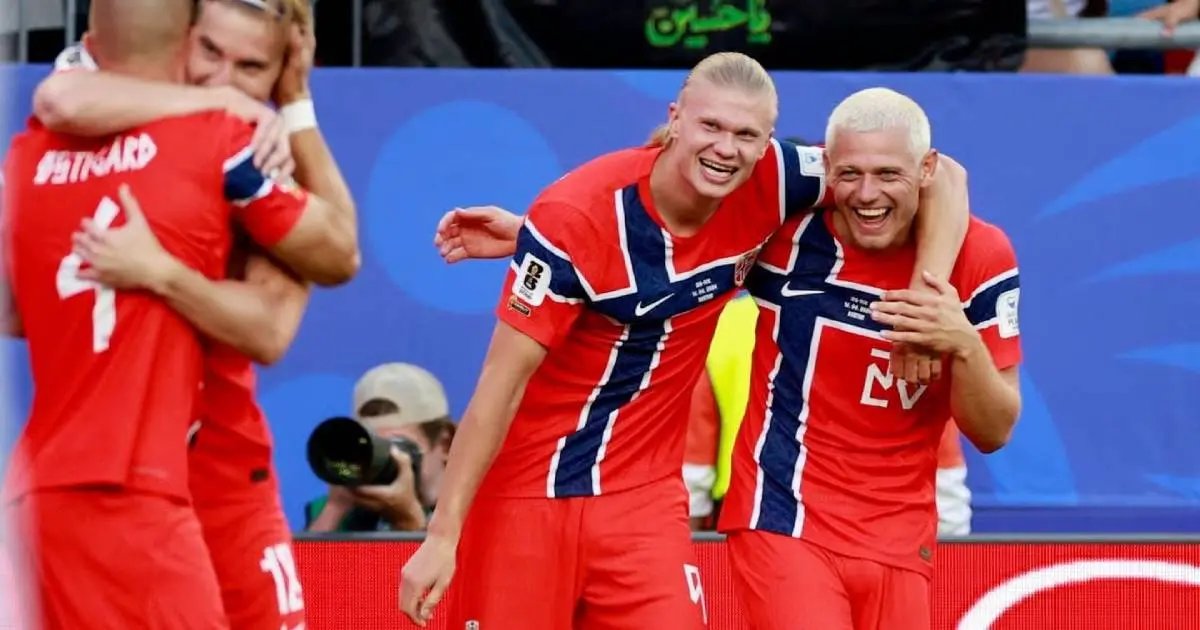
- Erling Haaland marked his FIFA World Cup debut with a clinical brace, propelling Norway to a 4-1 victory over a resilient Iraq side in Boston.
- Despite a brave equalizer from Aymen Hussein, Norway’s aerial dominance and high-intensity pressing forced critical defensive errors from the Lions of Mesopotamia.
- The win places Norway at the top of Group I, ending their 28-year World Cup hiatus with a statement performance powered by tactical discipline and individual brilliance.
Table of Contents
What Were the Tactical Setups for Iraq vs Norway?
The Iraq vs Norway opening fixture saw two distinct footballing philosophies collide at the Boston Stadium. Norway manager Ståle Solbakken opted for a balanced 4-3-3 formation, designed to maximize the creative output of captain Martin Ødegaard and the finishing prowess of Erling Haaland. The Norwegian backline featured Ørjan Nyland in goal, shielded by Julian Ryerson, Kristoffer Ajer, Torbjørn Heggem, and the attack-minded David Møller Wolfe.
In the midfield, Sander Berge provided the physical presence needed to disrupt Iraqi transitions, while Fredrik Aursnes worked tirelessly as the engine room connector. Up front, the trio of Alexander Sørloth, Erling Haaland, and the electrifying Antonio Nusa looked to exploit spaces behind the Iraqi defense. This setup allowed Norway to maintain a high defensive line and squeeze the play in the final third.
ALSO READ: France vs Senegal: Mbappe’s Brace Secures Win for Argentina
Iraq, led by Jesús Casas, countered with a structured 4-4-2 shape, emphasizing defensive solidity and direct counter-attacking. Jalal Hassan started between the sticks, supported by a back four of Hussein Ali, Zaid Tahseen, Akam Hashim, and Merchas Doski. The midfield four of Ibrahim Bayesh, Amir Al-Ammari, Zaid Ismael, and Ali Jasim was tasked with double-teaming Norway’s wingers, while Aymen Hussein and Ali Al-Hamadi led the line as a traditional strike partnership.
How Did Norway Break the Iraqi Resilience in the First Half?
The opening phase of this Iraq vs Norway encounter was a masterclass in patient, technical build-up play. Norway showcased their superior ball retention, initiating a highly technical 14-pass sequence starting from keeper Ørjan Nyland. The ball moved fluidly through the lines, eventually finding David Møller Wolfe on the left flank.
Wolfe delivered a pinpoint low cross into the corridor of uncertainty, allowing Erling Haaland to slide in and poke the ball home at the back post in the 29th minute. This goal underscored Haaland’s world-class movement and Norway’s ability to manipulate a low block. However, Iraq refused to crumble under the pressure of the European giants.
ALSO READ: Argentina vs Algeria: Messi Scores Hat-Trick to Help Argentina Win 3-0
In the 39th minute, Iraq found their route back into the game through sheer aerial dominance. Amir Al-Ammari delivered a delicate chipped cross into the box, where veteran striker Aymen Hussein rose highest. Hussein outmuscled Kristoffer Ajer to plant a powerful header past Nyland, momentarily drawing the scores level and igniting the Iraqi supporters in Boston.
Why Was the 43rd-Minute Blunder the Turning Point of the Match?
The technical superiority of the Iraq vs Norway clash was briefly overshadowed by a moment of defensive madness just before the interval. In the 43rd minute, a routine clearance became a catastrophe for the Iraqi side. A loose mix-up between defender Zaid Tahseen and keeper Jalal Hassan saw the ball bobble dangerously in the six-yard box.
Erling Haaland, ever the opportunist, relentlessly pressed the duo, causing a panicked clearance from Tahseen to deflect off Haaland’s knee and into the net. This freak goal shifted the momentum entirely, sending Norway into the locker room with a 2-1 lead. The psychological blow to Iraq was evident, as they had worked tirelessly to claw their way back only to gift the lead back to the “Terminator.”
This brace took Haaland’s unbelievable international tally to 57 goals in just 51 matches. For the Iraqi coaching staff, the blunder highlighted the thin margins at the elite level of the FIFA World Cup. Despite having a higher xG (Expected Goals) per shot in the first half, Iraq trailed due to an inability to handle Haaland’s relentless physical pressure.
How Did Ståle Solbakken’s Substitutions Secure the Victory?
As the second half progressed, the Iraq vs Norway tactical battle shifted toward squad depth. Solbakken recognized that Iraq was becoming increasingly dangerous on set pieces and introduced Leo Østigård in the 72nd minute to shore up the defense. The impact was immediate and decisive, showcasing Norway’s aerial prowess at both ends of the pitch.
Just four minutes after his introduction (76′), Østigård ghosted in completely unmarked at a Martin Ødegaard corner. The defender powered a thumping header home to make it 3-1, effectively ending Iraq’s hopes of a comeback. This goal was a result of a sophisticated blocking maneuver by Sørloth, which cleared a path for Østigård to exploit.
The match concluded in stoppage time (90+6′) with further misfortune for Iraq. During a late Norwegian corner, Aymen Hussein—the hero of the first half—inadvertently cleared the ball into his own net. The own goal rounded out the 4-1 scoreline, a result that perhaps flattered the Norwegians but reflected their clinical nature in the final third and their dominance in final-third entries.
What Is the On-the-Ground Perspective for East African Fans?
For fans in Kenya and across East Africa, the Iraq vs Norway match was more than just a Group I fixture; it was a showcase of Premier League royalty. In the pubs of Nairobi and the viewing centers of Mombasa, the “Ødegaard-Haaland” connection was the primary draw. Given the massive Arsenal and Manchester City fanbases in Kenya, every touch by the Norwegian captain was analyzed with intense scrutiny.
The match also sparked debates regarding the level of Asian football versus European consistency. While Iraq showed spirit, the tactical discipline of the Norwegians was the clear differentiator that local analysts highlighted on social media platforms like X (formerly Twitter).
Furthermore, the 28-year absence of Norway from the World Cup resonates with Kenyan fans who often dream of seeing the Harambee Stars on this stage. Seeing a mid-sized European nation return and dominate through a clear developmental path provides a blueprint that many local football enthusiasts discuss during post-match “mandazi and tea” sessions. The intensity of Iraq vs Norway serves as a reminder of the standards required for global competitiveness.
How Does This Result Impact the Group I Standings?
This Iraq vs Norway result significantly reshapes the expectations for Group I. Norway’s four-goal haul gives them a healthy goal difference, which could be crucial in a group that features other tactical powerhouses. With Haaland in this kind of form, Norway is no longer just a “dark horse” but a legitimate threat to win the group outright.
Iraq, conversely, must now focus on their upcoming fixtures as “must-win” games. Despite the 4-1 scoreline, Jesús Casas can take positives from their ability to disrupt Norway’s rhythm for 35 minutes. Their physical approach and success in aerial duels suggest they will be a handful for teams that lack Norway’s height and top-tier defensive coordination.
According to StatsPerform data, Norway’s probability of advancing to the knockout stages has jumped to 78% following this victory. The tactical versatility shown by Solbakken, switching from a fluid 4-3-3 to a more defensive posture late in the game, suggests a maturity that was missing in previous qualifying campaigns.
What Do the Advanced Metrics Tell Us About the Match Performance?
The statistical breakdown of the Iraq vs Norway match reveals a game of two halves in terms of efficiency. While possession was relatively balanced in the first 30 minutes, Norway’s ability to generate “Big Chances” was far superior. Martin Ødegaard finished the match with an xA (Expected Assists) of 0.82, the highest on the pitch, highlighting his role as the primary architect.
| Metric | Norway | Iraq |
|---|---|---|
| Goals Scored | 4 | 1 |
| Expected Goals (xG) | 2.64 | 0.91 |
| Total Shots | 16 | 7 |
| Shots on Target | 8 | 2 |
| Big Chances Created | 4 | 1 |
| Possession | 58% | 42% |
Norway also dominated the “Final-Third Entries,” tallying 42 compared to Iraq’s 19. This persistent pressure eventually forced the errors that led to the second and fourth goals. Defensively, Kristoffer Ajer led the match in clearances (6) and interceptions (3), proving vital in neutralizing the physical threat of Aymen Hussein after the Iraqi striker’s initial goal.

The SportsLeo Forecast for the next 6 months suggests that Erling Haaland’s market value—already estimated at €200 million—will continue to soar if he maintains this goal-per-game ratio on the world stage. Norway’s cohesive unit looks capable of reaching the quarter-finals, provided they avoid injuries to their core trio of Ødegaard, Haaland, and Berge. This dominant victory in the Iraq vs Norway opener serves as the perfect springboard for their 2026 campaign.
FAQ: Iraq vs Norway World Cup Group I Opener
Q1: What was the final score of the Norway vs Iraq match?
A1: Norway defeated Iraq 4-1 at the Boston Stadium to secure all three points and move to the top of Group I on goal difference.
Q2: Who scored the goals in Norway vs Iraq?
A2: Erling Haaland scored twice in the first half (29′ and 43′) and Leo Østigård scored a header in the 76th minute for Norway, alongside a 90+6′ own goal from Aymen Hussein. Iraq’s lone goal was scored by Aymen Hussein in the 39th minute.
Q3: How many international goals does Erling Haaland have after his World Cup debut?
A3: Following his spectacular brace against Iraq, Erling Haaland has scored an incredible 57 goals in just 51 international appearances for Norway.
Q4: When was the last time Norway played in a FIFA World Cup before 2026?
A4: Norway’s appearance in the 2026 tournament ends a 28-year drought, with their last World Cup tournament showing coming back in 1998 in France.
Q5: Who was the standout performer in the Iraq vs Norway match?
A5: While Erling Haaland took the headlines with two goals, Martin Ødegaard was the tactical heartbeat of the team, controlling the tempo and providing the assist for the third goal.