







- Prince Naseem’s story is one of swagger, skill, and knockout power that took him from the streets of Sheffield to global fame
- Naseem left the sport at the age of 28, which is pretty young for a boxer to retire
- He didn’t make a formal announcement about a long comeback
Prince Naseem Hamed’s story is one of swagger, skill, and knockout power that took him from the streets of Sheffield to global fame.
In this article, Sportsleo takes a look at how Naseem went from a poor background to becoming one of the best featherweights ever and leaving a lasting mark on the sport of boxing.
Life in the Beginning
Naseem Hamed was born on February 12, 1974, in Sheffield, England. His parents were Yemeni immigrants who worked hard to make ends meet. His dad owned a corner store, and his mom helped raise a big family in a city where steel mills were a big part of life.
Naseem was a very athletic and strong-willed young boy. He went to the famous Ingle Gym in Sheffield to train with Brendan Ingle, who turned his natural talents into something amazing.
He had an unusual style: low hands, fast feet, lightning-fast reflexes, and knockouts from strange angles. This would be a defining moment in Prince Naseem’s career.

Get Higher in the Ranks
At 18, Prince Naseem made his professional debut in April 1992. In the beginning, he chased and won European titles. He won the European Bantamweight Championship in 1994 and the WBC International Super Bantamweight title later that year.
These wins were the first steps toward what was to come. Naseem became famous all over the world because of his flashy entrances, showmanship, and real violence in the ring. The show was just as important as the skill.
People talked about his entrances as much as they talked about his fists. Sometimes he came in on a flying carpet, and other times he came in with lasers and strobe lights.
The Glory of the World Championship
Naseem reached a big goal in September 1995 when he beat Steve Robinson at Cardiff Arms Park to win the WBO Featherweight Championship. From then on, he would defend his titles, unify belts, and become one of the most feared featherweights in boxing history. He beat Tom Johnson in February 1997 to win the IBF title and add it to his collection.
Naseem won the WBC featherweight title in October 1999 by beating Cesar Soto. His record was 35-0 at its best, but he later lost his first and only professional fight.
One of the most exciting times in his career was probably when Naseem knocked out Vuyani Bungu in the fourth round in London on March 11, 2000, in front of a huge crowd.
Style, Showmanship, and Legacy
It wasn’t just Prince Naseem’s record that made him stand out; it was also how he fought and how he acted. He had a lot of southpaw power, strange angles, and amazing reflexes.
Naseem fought in a way that went against the rules of boxing: he often kept his hands low, made fun of his opponents, and let his fists do the talking. A lot of people said it was revolutionary.
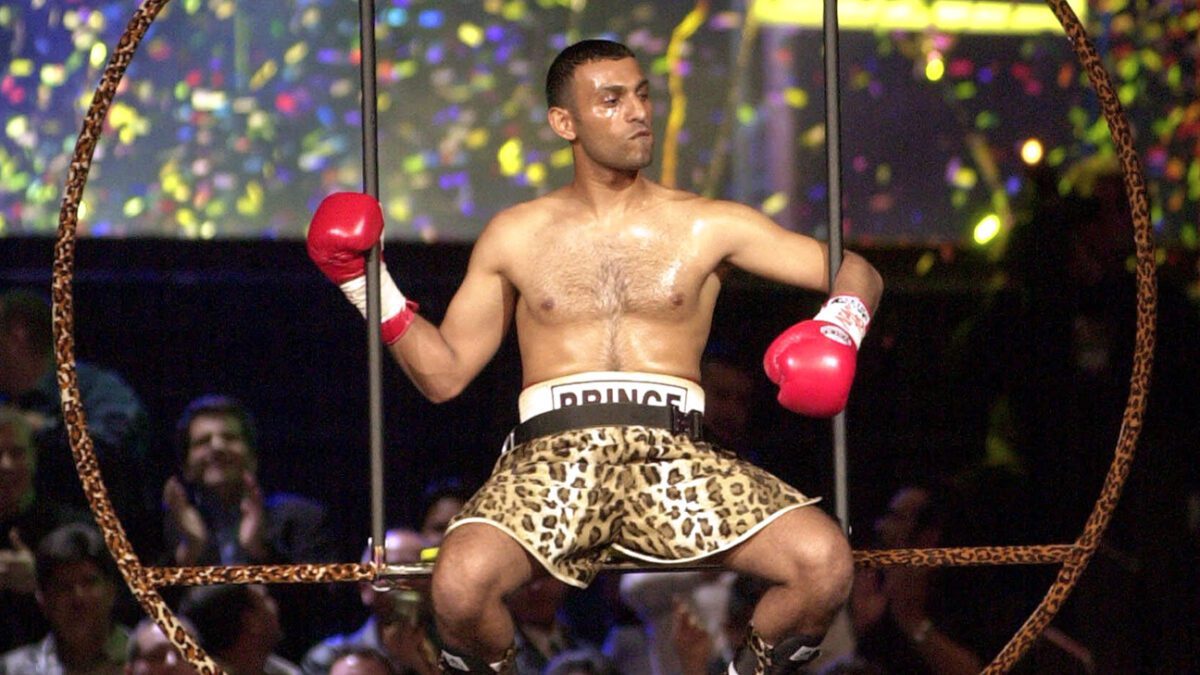
Naseem was a showman outside of the ring. He made boxing an event with his leopard-print shorts and dramatic entrances to the ring. The cultural impact was real: he inspired British-Asian youth, brought a new kind of bravado to the lighter weight classes, and helped boxers make a lot of money outside of the heavyweight glamour.
Another part of his legacy is how he made featherweight boxing more popular at a time when heavier weights and bigger personalities were the norm. Naseem may have been small, but he had big goals and made a big difference.
The Turning Point and the End of His Career
Naseem fought Marco Antonio Barrera in Las Vegas on April 7, 2001, for the IBO featherweight title. He lost by unanimous decision, which was his first loss as a professional. That fight was the start of the end of his reign. Problems with discipline, motivation, and injuries to the hands became clear.
His last fight was in London on May 18, 2002, against Manuel Calvo. Naseem won by unanimous decision, took home the IBO title, and then quietly left the sport not long after. He had a record of 36 wins (31 by knockout) and only 1 loss at the end.
Naseem left the sport at the age of 28, which is pretty young for a boxer to retire. He didn’t make a formal announcement about a long comeback.
Personal Life and Problems
Prince Naseem’s life story is about faith, identity, and controversy, not just boxing. He is a Yemeni Muslim who has talked openly about his background and beliefs.
In 1998, he married Eleasha Elphinstone, who had been his partner for a long time. They have two sons, Aadam and Sami, who are also boxers.
But Prince Naseem’s life hasn’t always been easy. He was in a bad car accident in 2005 while speeding, and in 2006 he pleaded guilty to dangerous driving and spent several months in prison. After that, he lost his MBE honor.
These events made Naseem’s legacy more complicated. He was known for being great in the ring, but he was also human and had flaws outside of it.
The Famous Ring Walks That Changed Boxing
Prince Naseem Hamed was unforgettable not only because of how he fought, but also because of how he got into the ringhis famous ring walks.
The British star had already caught the crowd’s attention with entrances that were theatrical, dramatic, and sometimes unbelievable long before the first punch was thrown. Naseem turned the ring walk into a full entertainment show in many ways, changing how boxing events were presented.

In March 2000, before his fight with Vuyani Bungu in London, he had one of his most famous moments. Most fighters walk down the aisle, but Naseem looked like he was hanging from the ceiling of the arena on a “magic flying carpet,” slowly descending toward the ring in front of thousands of fans.
The dramatic entrance shocked the crowd and made this one of the most famous ring walks in boxing history right away. After getting into the ring, he knocked out Bungu in the fourth round, showing that he could fight as well as show off.
Interestingly, Naseem’s creativity didn’t stop there. During his 1998 fight against Wayne McCullough on Halloween night, he came into the arena through a creepy graveyard set while dancing to Michael Jackson’s hit song “Thriller.”
There was smoke, skeleton props, creepy music, and confetti at the entrance, making the fight feel more like a play than a sporting event.
Naseem tried out a lot of different fancy entrances during his career. Sometimes he walked down a long runway with flashing lights and confetti all around him. Other times, he wore dramatic costumes, crowns, or robes, or he came into the arena with dancers and choreographed music.
These entrances used lasers, strobe lights, fireworks, and themed stage shows that were much more over-the-top than what most fighters had done before.
At a time when boxing matches were still pretty traditional, Naseem’s showmanship made his fights feel more like WWE-style sports entertainment shows. His entrances sometimes lasted several minutes and were carefully planned to get people excited before the fight even started.
Fans knew that something crazy would happen whenever “Prince Naz” was going to fight, and the ring walk itself became part of the show.
These entrances served a psychological purpose in addition to being fun. Naseem knew how to use his showmanship to scare or annoy his opponents before the fight even started.
The Briton made his opponents wait in the ring while the crowd cheered for him by dancing, posing, and taunting them as he came in. This often made it hard for them to focus and made things tense before the first bell.
His confidence during these performances sent a message to his opponents that he was the better fighter in the ring. Some opponents looked annoyed or distracted by the show, but fans were excited by it. When Naseem finally did his trademark move of flipping over the top rope into the ring, the crowd would go wild.
It is clear now that Prince Naseem’s entrances changed the way people think about boxing. Tyson Fury and other modern fighters now use elaborate walkouts with music, costumes, and choreography.
Naseem was one of the first fighters to turn the ring walk into performance art. Fans remembered his entrances as much as his knockouts because he was so charming, stylish, and willing to entertain.
Impact on Boxing and Culture
Naseem changed how boxing saw smaller fighters by being a dominant featherweight and a magnetic performer. He showed that you didn’t have to be a heavyweight to get big paydays, worldwide attention, or make a name for yourself. Trainers and fighters all over the world say he had an impact. +1
His arrival as a British-Asian sports star also inspired a new generation of athletes from underrepresented groups. Prince Naseem’s presence was important in a sport that doesn’t always have a lot of diversity. His entrances into the ring, his confidence, and his refusal to be quiet all had a big impact outside of Sheffield.

Why His Story Is Still Important
The story of Prince Naseem is still important even years after he retired. In a time of fake hype and fake personalities, his showmanship felt real. He backed up what he said with his fists. His moments, like coming into the ring on a magic carpet to defend his title, are part of boxing history.
When modern fighters talk about their legacy, earnings, and influence, they still use Naseem’s example. His record is still there, his best moments are still there, and people still argue about his style. He may not have fought until he was in his 30s like some of his peers, but what he did in that time was huge.
Achievements & Highlights
-
Multiple-time featherweight world champion (WBO, IBF, WBC).
-
World-class knockout artist: 31 KOs in 36 wins.
-
Inducted into the International Boxing Hall of Fame in 2015.
-
A pioneer for lighter-weight champions earning mainstream recognition.
-
A culturally significant figure, both as a British-Asian and as a global sports entertainer.
Conclusion
Prince Naseem story is one of brilliance, daring, and style that can’t be beat. He wowed crowds with his style, spirit, and strength, from the gym in Sheffield to world title fights in London, Las Vegas, and beyond. He had both talent and personality, which made for moments that went beyond sports.
Naseem’s legacy will last long after his career is over. In boxing, records fade and fights end, but memories, icons, and examples stay. He showed us what it means to fight with passion and style, two things that will always be in style.
FAQs
Why did Naseem Hamed retire so early?
Nasem revealed during an interview with BBC Radio Sportsweek that his retirement was largely due to chronic problems with his hands, including multiple fractures as well as surgery. Naseem was inducted into the International Boxing Hall of Fame in 2015.
What happened to boxer Prince Naseem?
What is Prince Naseem’s biggest regret?
The boxer ‘Prince’ Naseem Hamed has revealed his biggest regret in life. In an interview with The Guardian, he said: “So my biggest regret is that, when I was younger, I didn’t always do my five prayers. But I do now, and it’s so important because the person I am today is the person I’ve always wanted to be.
Who defeated Prince Naseem?
On April 7, 2001 in a fight billed as “playing with fire” Marco Antonio Barrera outclassed Prince Naseem Hamed to win the vacant IBO featherweight title and Hamed’s linear featherweight title.
Discover more from Sportsleo News
Subscribe to get the latest posts sent to your email.