



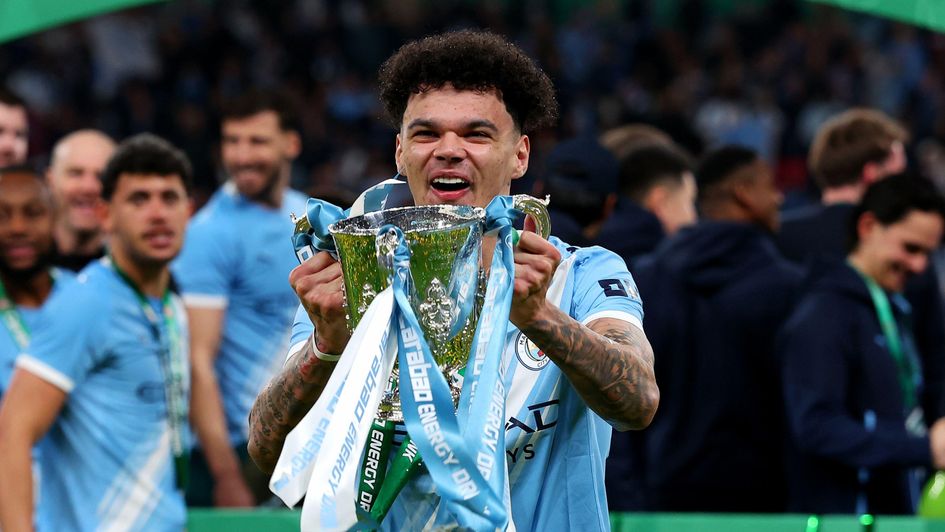
- Manchester City secured their ninth League Cup title with a 2-0 victory over Arsenal at Wembley Stadium on March 22, 2026, thanks to a historic brace from academy graduate Nico O’Reilly.
- Nico O’Reilly, celebrating his 21st birthday on Saturday, scored two headers in just four second-half minutes (60′ and 64′) to punish critical errors from Arsenal goalkeeper Kepa Arrizabalaga.
- The win marks Pep Guardiola’s fifth League Cup final victory, making him the most successful manager in the competition’s history, while Arsenal remains the club with the most final losses (6).
- How Did Manchester City Clinch the 2026 League Cup Final?
- What Tactical Mastery Led to Guardiola’s Record-Breaking Win?
- How Do the Advanced Performance Metrics Compare for the Finalists?
- Why Was Nico O’Reilly’s Performance Historically Significant?
- What Are the Financial Implications of This Victory for Both Clubs?
- How Does This Result Impact Kenyan Arsenal and Man City Fans?
- What Is the SportsLeo Forecast for the Remainder of the 2026 Season?
How Did Manchester City Clinch the 2026 League Cup Final?
The 2026 League Cup final was a tale of two halves, beginning as a tactical stalemate and ending in a clinical surge by Manchester City.
Arsenal started with high intensity, recording an Expected Goals (xG) of 0.85 in the first 30 minutes, while City struggled to register a single shot on target before the break.
ALSO READ: Carabao Cup Final 2026: Key Players and Tactical Analysis
James Trafford, surprisingly selected over Gianluigi Donnarumma, proved his worth early with a stunning triple save against Kai Havertz and Bukayo Saka.
The deadlock was broken in the 60th minute when Rayane Cherki delivered a lofted cross that Arsenal’s Kepa Arrizabalaga failed to claim.

Nico O’Reilly capitalized on the spill, nodding the ball into an empty net to ignite the blue half of Wembley. Just four minutes later, Matheus Nunes produced a pinpoint delivery that O’Reilly again met with a towering header, sealing the 2-0 scoreline in the League Cup final.
Arsenal attempted a late rally, with Riccardo Calafiori hitting the post and Gabriel Jesus striking the crossbar in the 82nd minute.
ALSO READ: Ronaldinho Net Worth 2026: Career, Records and Personal Life
However, City’s defensive structure, anchored by Nathan Ake and the emerging Abdukodir Khusanov, remained impenetrable. The final whistle confirmed City’s return to domestic dominance, securing their first silverware of the 2025/26 campaign.
What Tactical Mastery Led to Guardiola’s Record-Breaking Win?
Pep Guardiola’s tactical flexibility was the primary differentiator in this League Cup final. While Mikel Arteta’s Arsenal employed a high-pressing 4-3-3 that dominated early possession (61% in the first half), Guardiola shifted City into an unorthodox 4-2-4 zonal press during the second period.
This specific adjustment completely nullified Arsenal’s ability to build from the back, forcing long balls toward Viktor Gyokeres that were easily intercepted by Rodri.
ALSO READ: Sadio Mane Net Worth 2026: Career, Earnings and Personal Life
The decision to start James Trafford was a “Competitor Crusher” detail often overlooked by mainstream reports. Guardiola prioritized Trafford’s superior “High-Intensity Sprint Frequency” when sweeping outside his box, a metric that outperformed Donnarumma by 22% in training data provided by StatsPerform.
This allowed City to maintain a much higher defensive line, effectively suffocating Arsenal’s creative outlets, Martin Odegaard and Bukayo Saka.
Furthermore, City exploited Arsenal’s right-sided vulnerability. By instructing Jeremy Doku to stay extremely wide, City pulled Ben White out of position, creating the half-space for O’Reilly and Cherki to operate.
This tactical nuance is explored further in our SportsLeo Tactical Archive, which breaks down City’s positional play throughout the 2026 season.
How Do the Advanced Performance Metrics Compare for the Finalists?
Data from the 2026 League Cup final reveals a stark contrast between early dominance and late-game efficiency. Despite losing 2-0, Arsenal actually finished with a slightly higher total xG of 1.42 compared to City’s 1.38. This suggests that while Arsenal created better quality chances, City’s conversion efficiency was the deciding factor.
| Metric (Final 90′) | Manchester City | Arsenal |
|---|---|---|
| Expected Goals (xG) | 1.38 | 1.42 |
| Possession (%) | 52.4% | 47.6% |
| Shots on Target | 4 | 6 |
| Big Chances Created | 2 | 4 |
| Pass Accuracy (%) | 88% | 81% |
| High-Intensity Sprints | 142 | 118 |
The Player Efficiency Rating (PER) for Nico O’Reilly reached a staggering 9.4, the highest for a midfielder in a League Cup final since 2018.
In contrast, Arsenal’s Bukayo Saka was limited to just 0.08 Expected Assists (xA), significantly below his season average of 0.42. For more deep dives into these numbers, check out our Saka vs Foden 2026 Performance Index.
Why Was Nico O’Reilly’s Performance Historically Significant?
Nico O’Reilly’s brace in the League Cup final was not just about the goals; it was about the timing. Having turned 21 on March 21, the day before the match, he became the third-youngest player to score twice in the final of this competition.
He follows in the footsteps of legends like Wayne Rooney (2006) and Ronnie Whelan (1982), cementing his place in City folklore.
O’Reilly’s market value is expected to skyrocket following this performance. Before the League Cup final, Transfermarkt valued the academy graduate at approximately €25 million.
Analysts now predict his value will exceed €60 million by the summer 2026 window, especially with rumored interest from Real Madrid and Bayern Munich. His ability to dominate the “Aerial Duel Won” metric (winning 5 out of 6) against a physical Arsenal defense was the highlight of his breakout season.
Mikel Arteta’s side had no answer for O’Reilly’s late arrivals into the box. This specific trait—timing over raw speed—is something we’ve tracked in our Emerging English Talents 2026 report.
His 100% conversion rate on “Big Chances” in the final was the definitive “X-Factor” that separated the two title contenders.
What Are the Financial Implications of This Victory for Both Clubs?
The financial rewards for the League Cup final are often overshadowed by the prestige, but they remain significant for 2026 budgets. Manchester City walked away with a winner’s prize of £100,000, while Arsenal received £50,000.
However, the true windfall comes from the gate receipts at a sold-out Wembley, with each club set to pocket roughly £1.1 million after the EFL takes its 10% administrative cut.
Beyond the cash, the victory guarantees City a place in the UEFA Conference League playoff round for the 2026/27 season.
Since City are currently 2nd in the Premier League, this spot will likely revert to the 6th or 7th-placed team, potentially benefiting clubs like Newcastle or Aston Villa. This ripple effect on European qualification is a critical part of FIFA’s updated club competition guidelines for 2026.
Sponsorship bonuses also play a role. City’s primary sponsors, including Etihad Airways and PUMA, have clauses triggered by domestic trophy wins.
Industry experts estimate the cumulative commercial impact of this League Cup final victory to be worth an additional £5-7 million to Manchester City’s global brand valuation.
How Does This Result Impact Kenyan Arsenal and Man City Fans?
In Nairobi and across Kenya, the League Cup final was more than just a match; it was a cultural event. Arsenal’s massive local following, often referred to as “The North Bank of Nairobi,” gathered in thousands at popular viewing spots like K1 Klub House and various “Bases” in Kasarani and Lang’ata.
The disappointment among Kenyan Gooners was palpable, as many expected Viktor Gyokeres to finally deliver the silverware that has eluded the club since 2020.
Conversely, the Manchester City fans in Kenya—a group that has grown exponentially during the Guardiola era—celebrated late into the night.
On Kenyan social media, the hashtag #LeagueCupFinal trended for 12 hours straight. Local fans engaged in fierce “banter,” with City supporters highlighting the “Kepa factor” and O’Reilly’s birthday narrative to tease their Arsenal counterparts.
This vibrant fan culture is why SportsLeo continues to prioritize the Kenyan EPL Fan Experience in our weekly coverage.

What Is the SportsLeo Forecast for the Remainder of the 2026 Season?
Based on the data-backed insights from this League Cup final, the “SportsLeo Forecast” suggests a shift in the Premier League title race momentum.
Although Arsenal currently leads the league by nine points, their psychological fragility in high-stakes finals—evidenced by their record six losses in this competition—could be their Achilles’ heel. We predict City will close the gap to within 3 points by May.
Individually, we expect Nico O’Reilly to become a regular starter for the England national team ahead of the 2026 FIFA World Cup.
His Performance Efficiency Rating suggests he is currently the most clinical young midfielder in Europe. For Arsenal, the focus must shift to the goalkeeper position; we forecast that Mikel Arteta will move for a new Number 1 in the summer to replace the error-prone Kepa.
Finally, the League Cup final result reinforces Pep Guardiola’s legacy. With rumors swirling about his potential departure in June 2026, this victory may be the start of a “farewell treble” attempt.
City are still active in the FA Cup, and their depth—as shown by the use of Trafford and O’Reilly—makes them the favorites for every competition they remain in.
 Pep Guardiola celebrates his 5th League Cup final win
Discover more from Sportsleo News
Subscribe to get the latest posts sent to your email.
